
ReferenceHardware
Hardware
The numbers and conventions of the MAKIINA arm, actuator, head and robot that matter when you write code.
The product pages on makiina.com describe the hardware in full. This page keeps the facts you need while programming it.
The arm
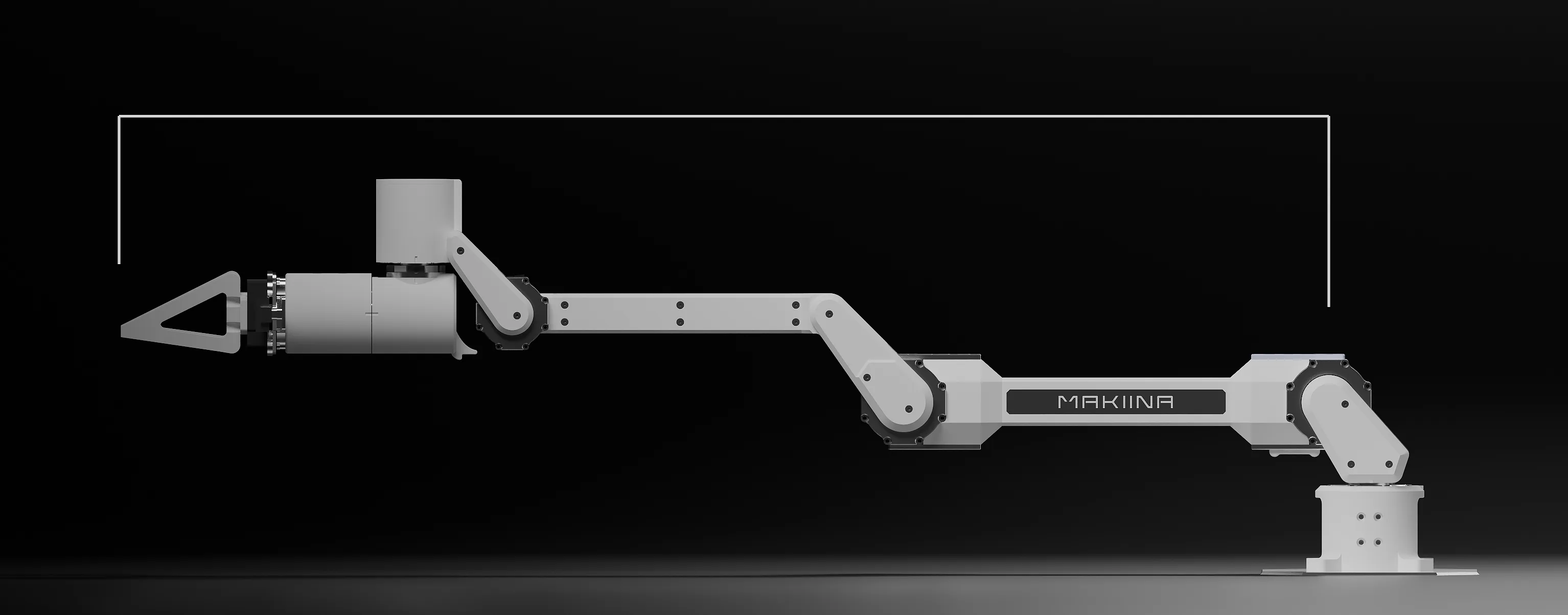
| Degrees of freedom | 6, plus a parallel gripper |
| Reach | 720 mm (extended edition) |
| Weight | 2.4 kg |
| Peak payload | 1.5 kg, measured without the gripper |
| Structure | CNC machined aluminium |
| Actuators | MAKIINA cycloidal, 22 N m peak at the base joints |
| Control | 14 kHz current loop on every drive; position, velocity, current and torque modes |
| Bus | one CAN bus per arm, 1 Mbit/s, one USB CAN adapter per arm |
| Power | 24 V; the dual arm system needs a 500 W supply |
Joints from the base to the gripper, with the right arm's names (the left arm's end in -L):
| Joint | Name | Moves | Motor size |
|---|---|---|---|
| J1 | J01-R | base yaw | big (medium preset) |
| J2 | J02-R | shoulder | big |
| J3 | J03-R | elbow | big |
| J4 | J04-R | forearm roll | small (small preset) |
| J5 | J05-R | wrist pitch | small |
| J6 | J06-R | wrist roll | small |
| gripper | trigger "right" | the two fingers; positive closes | small |
Every joint has a 39:1 cycloidal reducer. Velocity limits you set with safety.set_max_joint_velocity are in rad/s at the joint; the SDK converts them for each drive.
The zero pose has every joint on its alignment mark, the arm stretched straight out and the gripper open. model.named_poses() also holds neutral, a folded ready pose.
The Medium Actuator
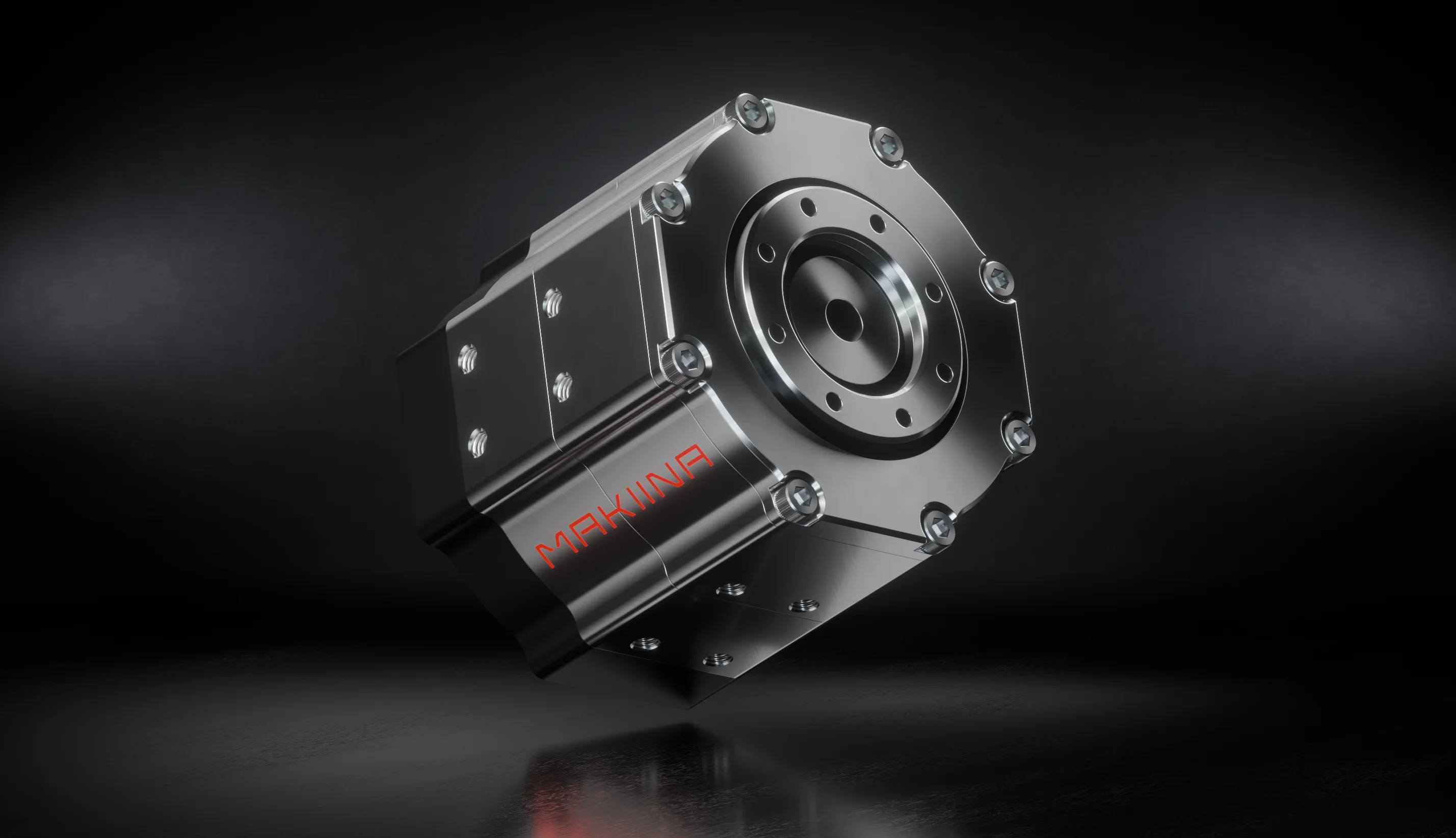
| Size | 50.1 x 50.1 x 47 mm |
| Weight | 240 g |
| Reducer | 39:1 cycloidal |
| Rated torque | 10 N m |
| Peak torque | 22 N m |
| Top output speed | 117 rpm |
| Output bearings | 2, each 238 N axial and 950 N radial |
| Encoders | single or dual, 16-bit |
| Sensing | phase current, temperature |
| Drive | integrated, STM32G4, 14 kHz current loop, 40 A peak phase current |
| Bus | FDCAN or classic CAN, power and data daisy-chained |
| Supply | 24 V, 2 to 3 W idle |
On the bus a drive answers on an even 11-bit id derived from its chip's serial number, and sends its state on the odd id next to it. It keeps its part, joint number, zero, direction and motor preset in its own memory.
The head
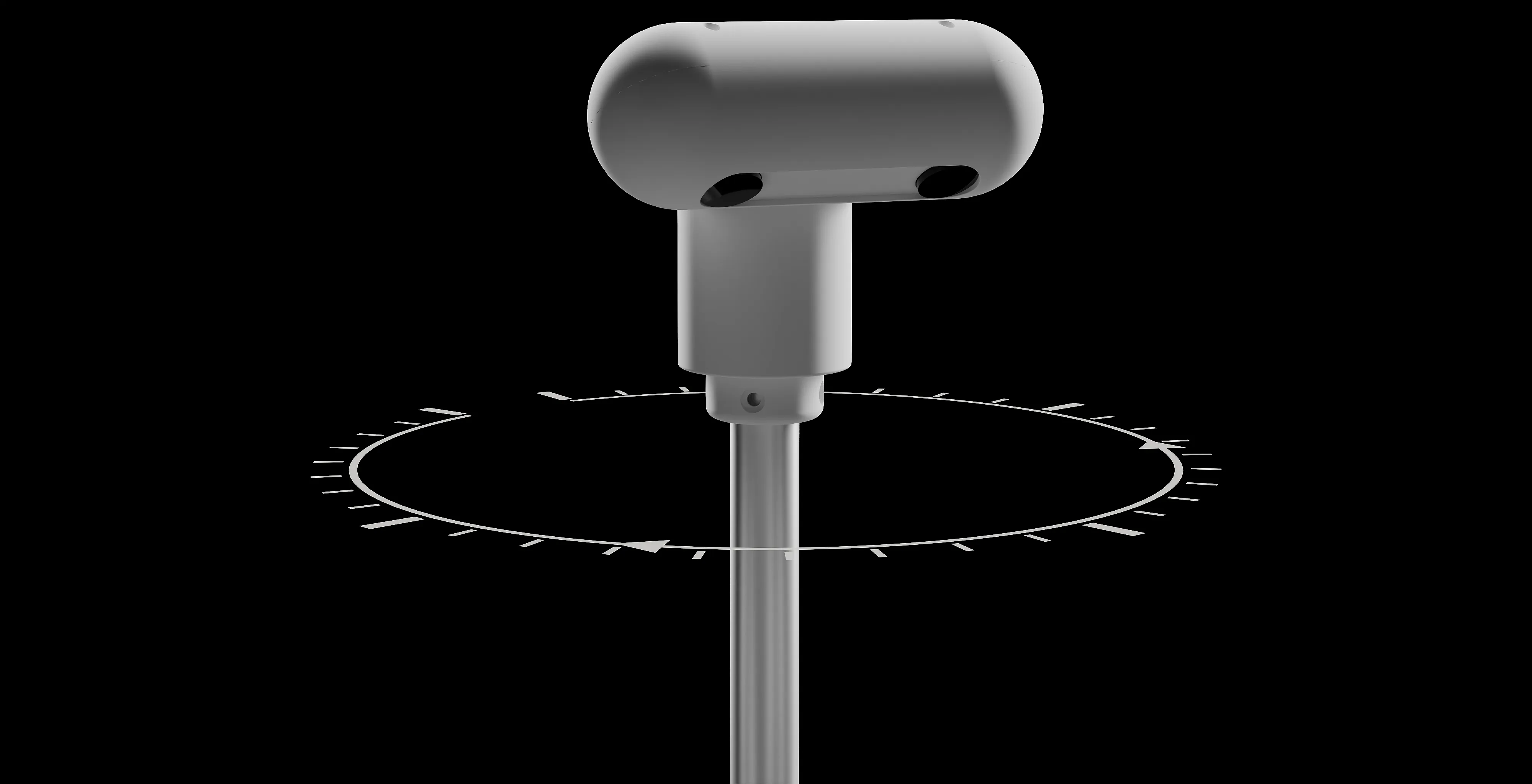
A turning stereo head: two wide cameras, a yaw drive (head, radians, positive to the robot's right, 0 straight ahead) and foveated streaming. In a session it streams both context cameras (1152 x 648) and both foveas (640 x 640) at 56 frames per second per eye, and with a gripper camera computer, a camera on each gripper (224 x 224). The foveas are cut from the cameras at 2304 x 1296 across the full field of view, so the detail you can point at is that of a 2304 x 1296 camera per eye, a combined 4608 x 1296 across both eyes.
The robot
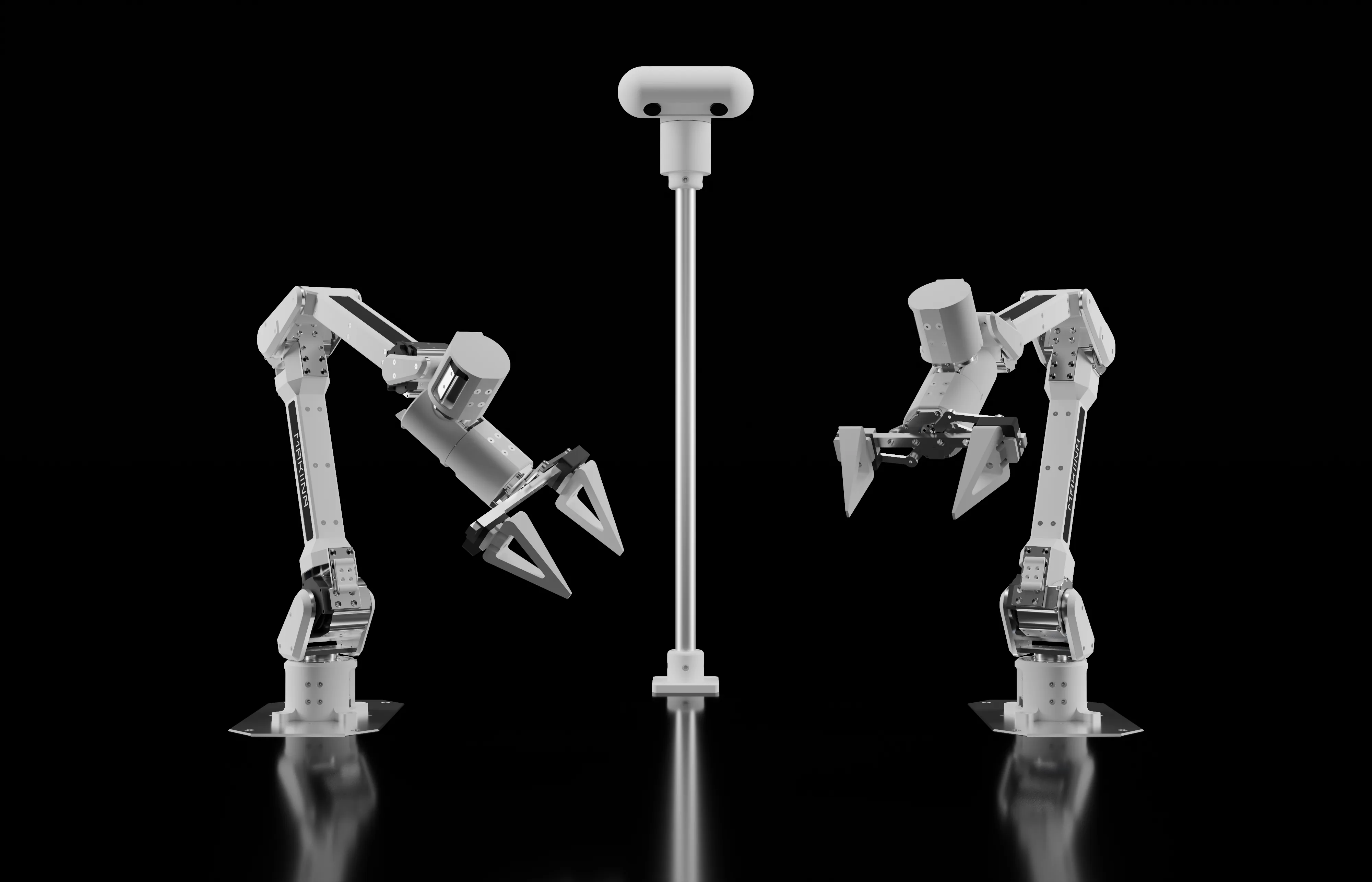
Two arms and the head, with one or two small computers. The head's computer runs the robot server, the cameras and the connection to MAKIINA Cloud; a second computer can serve the gripper cameras. You reach it through the fleet, or directly on your LAN.
USB CAN adapters
The SDK works with candleLight USB CAN adapters at 1 Mbit/s. The adapters that come with MAKIINA hardware are ready to use; your own must run candleLight firmware. On Linux your user needs permission to open it (a udev rule, see Install the SDK).
On the bench
- Keep a hand near the power switch while you try something new.
- Set
safety.set_torque_fraction(0.4)andsafety.set_max_joint_velocity(1.0)before the first motion command. torque_off()lets the arm fall under its own weight. Hold it first.zerostretches the arm to its full reach. Clear the space first.